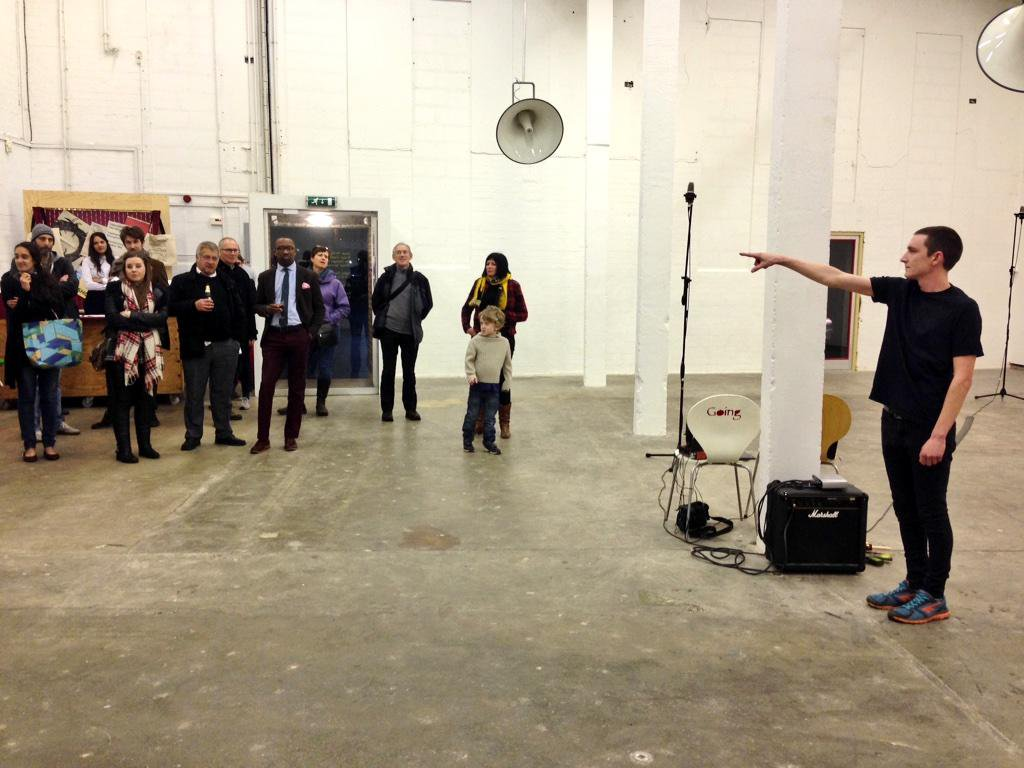
This piece is about how music is disciplined and about how it can be a collective activity. I adopt the manner of a military drill sergeant and coerce an audience to rote-learn a jingoistic song. The coercion is made explicit: rather than me trying to be ‘nice’ to the audience I am deliberately antagonistic by shouting and pointing at them.
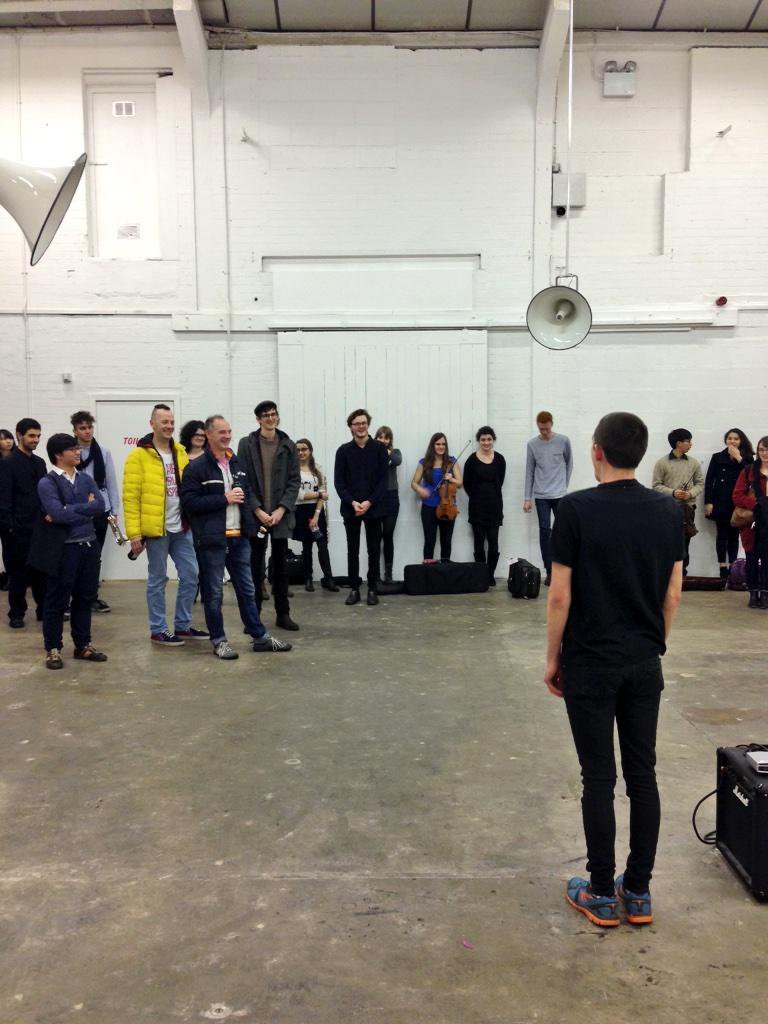
This video is a short extract of performance that lasted seven minutes in total, so some description of the piece is required. I stood in front of an audience at an art gallery opening event (Eastside Projects in Birmingham) with the audience stood informally around the gallery facing me. A sound installation (Broken Ensemble: War Damaged Musical Instruments (brass section), 2014) by artist Susan Philipsz played through large speakers around me. My performance was part of a showcase event of musical responses to the installation. Philipsz had suspended a group of large horn-shaped speakers in the gallery, which played pre-recorded tracks of war-damaged bugles playing tones from the ‘Last Post’, a bugle call used by the army to bring the troops home, and now used to commemorate all victims of war. It symbolises an ending. I decided to perform something that was used as a beginning to war, as a mirror to Philipsz’s work. I memorised the refrain from a patriotic song that was used to recruit British men into the army during the opening years of World War 1: Your King and Country Need You with lyrics by Huntley Trevor and music by Henry E. Pether (Farrington, 1914). I broke the refrain down into six parts and shout-sang single lines. After I had shout-sang each line I pointed to the audience in the manner of the famous Lord Kitchener Wants You poster by Alfred Leete (1914), indicating that the audience should repeat the line. Once the audience understood what I wanted, which took about a minute, they reluctantly joined in with the singing.
Susan Philipsz’s installation played throughout my performance. I began by shout-singing the first line of the song, then pointing at the audience for the same duration as the shouted line. I kept doing this until the audience joined in on their cue. Once I was satisfied with the audience’s response to each line I progressed to the next line, occasionally going back to the beginning and shouting two lines at a time to encourage the audience to get used to the song and commit it to memory. I had to perform this with some sensitivity to how the audience might react, so the exact structure was not determined beforehand. I left it to my own intuition as to how much of the song to repeat, and was prepared to cut the performance short if I felt that the audience were uncomfortable with the action. The performance ended with me shout-singing the whole refrain. The experience was like rote-learning, which is exactly what we were doing as a group.

Performance
5 December 2014, Eastside Projects, Birmingham
 Andy Ingamells